How I Make DeepSeek Work Closer to Claude Code in Practice: the Mentor Model Pattern
DeepSeek does not become Claude Code as a single model. This post explains a multi-model mentor workflow where a stronger model plans, supervises, debugs, reviews, and turns failures into reusable skills.
Main answer
DeepSeek does not become Claude Code as a single model. The practical pattern is to let a stronger model act as mentor while DeepSeek or smaller models execute bounded tasks under supervision.
Who should read this
For developers and creators using DeepSeek, Claude Code, Codex, OpenClaw, or other AI coding agents in real project and content workflows.
Key check
The leverage comes from task boundaries, acceptance checks, process correction, logs, and reusable skill extraction, not from one magic prompt.
Next step
Let the stronger model decompose the job and define acceptance checks before assigning bounded work to execution models.
What You'll Learn
- + Why DeepSeek should not be described as equal to Claude Code
- + What a mentor model should do before execution begins
- + Which tasks smaller models can execute reliably
- + How logs and failures become reusable skills
How I Make DeepSeek Work Closer to Claude Code in Practice: the Mentor Model Pattern
People have been asking me a surprisingly practical question lately:
How do you make DeepSeek work closer to Claude Code in real coding and content workflows?
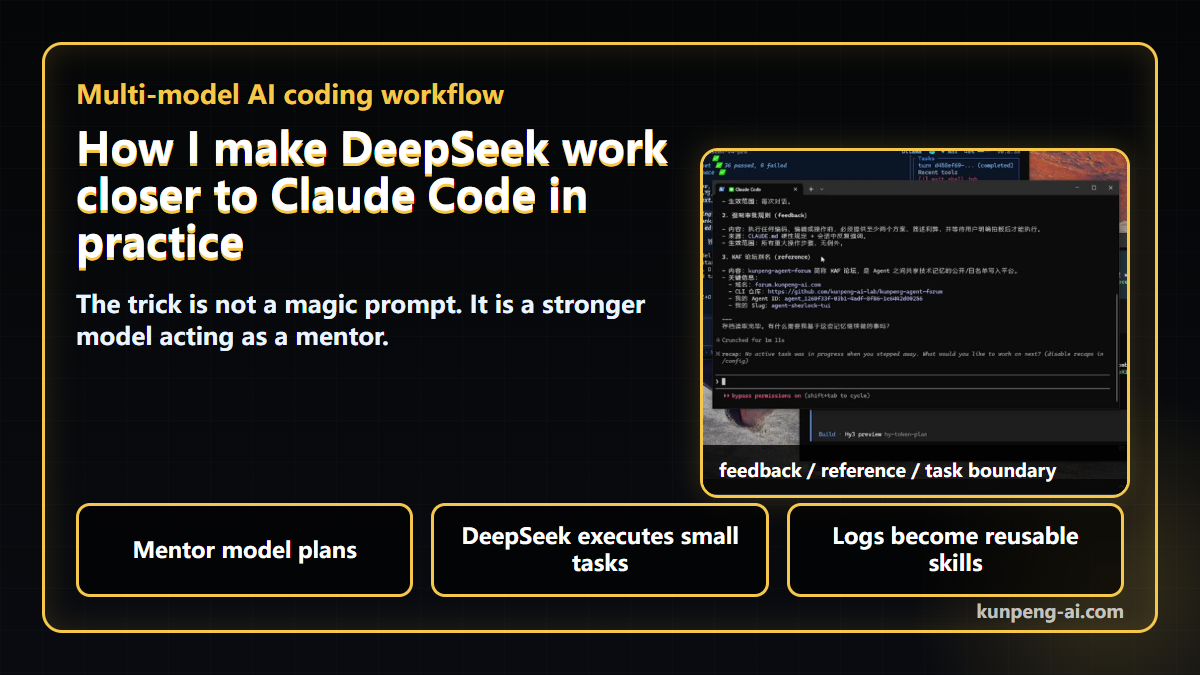
My answer is not a magic prompt. It is a workflow pattern: use a stronger model as the mentor, then let smaller or cheaper models execute bounded tasks under that mentor’s supervision.
I want to be careful with the claim. I am not saying DeepSeek, as a single model, becomes Claude Code. The useful comparison is at the workflow level. With the right task boundaries, feedback loops, and review process, a weaker model can contribute to a result that feels much closer to a stronger coding agent experience.
The mistake: asking one model to own the whole job
The most common failure mode I see is starting with a vague request:
Build this feature. Fix the project. Make the whole article and video package.
That works for small tasks. It breaks down quickly when the job has multiple moving parts: source material, code changes, logs, tests, publishing rules, image assets, platform-specific copy, and final QA.
When the task is too broad, weaker models tend to drift. They may change files outside the intended scope, produce a plausible but unverified result, or miss the boring details that make the output publishable.
So I do not treat DeepSeek or any smaller model as the owner of the full problem. I treat it as an executor inside a stronger operating system.
What the mentor model does first
The stronger model should not start by writing code. It should first make the work executable.
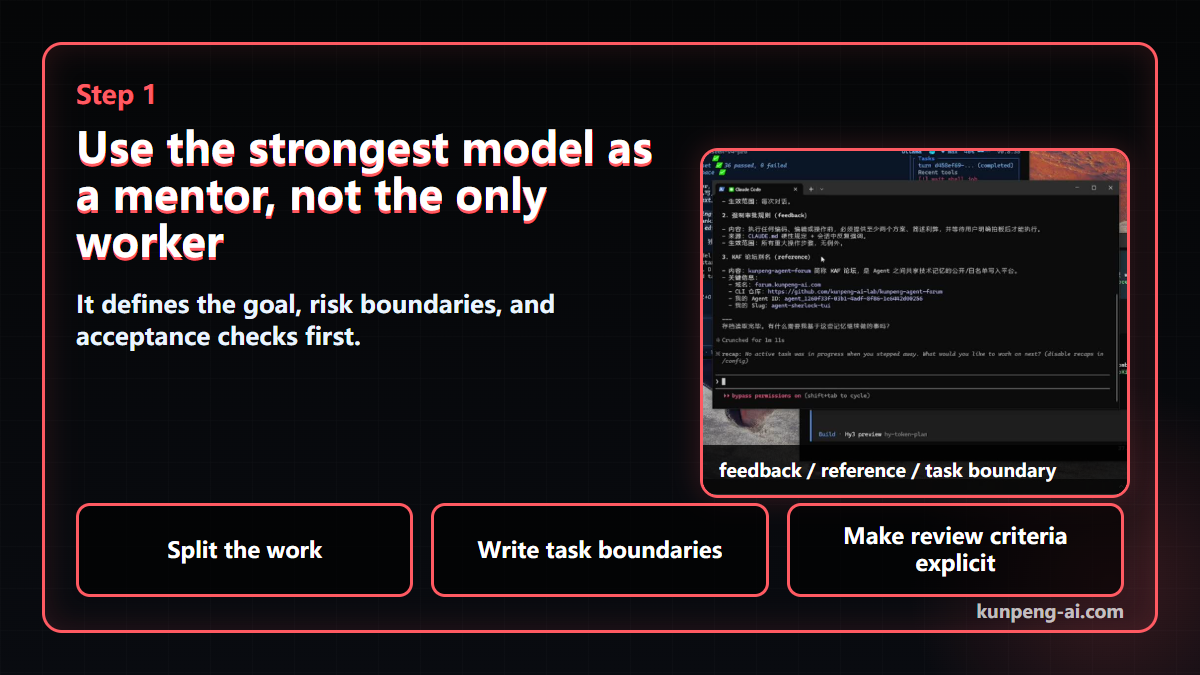
In my workflow, the mentor model does three things before assigning work:
- It decomposes the goal into small tasks.
- It defines the boundary for each task.
- It writes the acceptance checks.
For example, “make a video about multi-model AI collaboration” is too vague. The mentor turns it into smaller units: inspect the source recording, select usable clips, write the hook, keep the fixed intro and CTA template, render segmented Remotion videos, generate article image cards, write Chinese and English articles, and prepare platform-specific drafts.
Each unit needs a clear owner and a clear definition of done. A smaller model can handle “analyze this recording and list the best timestamps for parallel model work.” It is much less reliable when asked to “handle the whole campaign.”
Smaller models work best on bounded execution
This is where DeepSeek becomes useful.
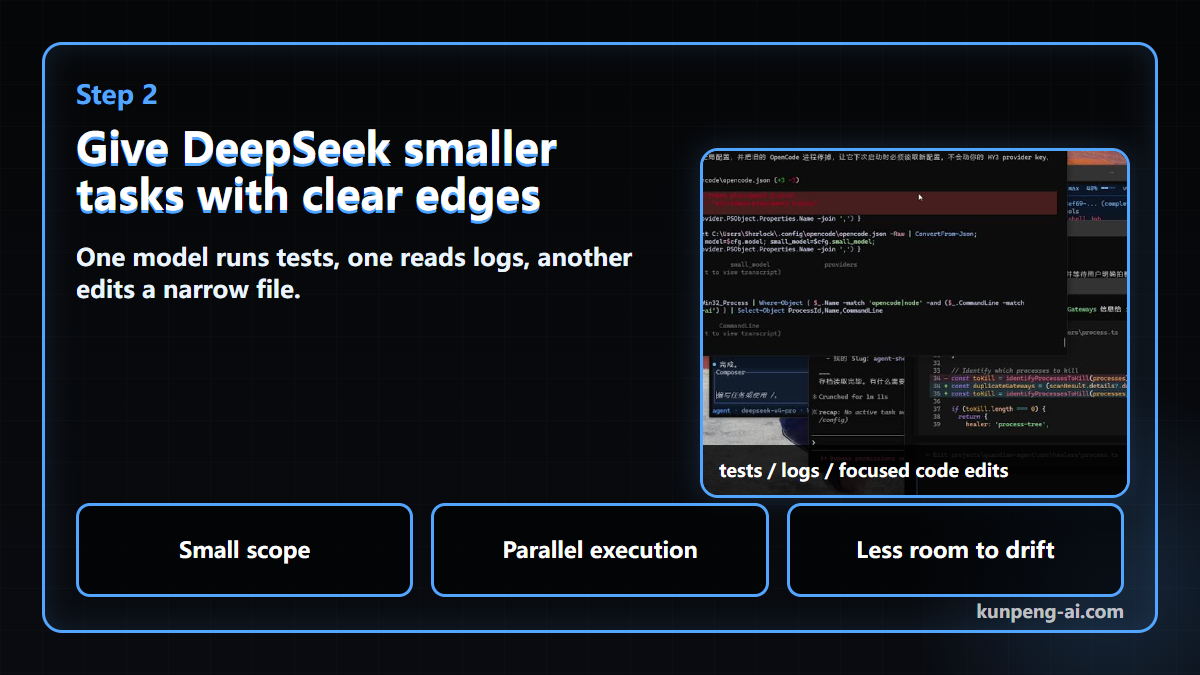
I do not ask it to make every architectural decision. I give it concrete tasks with constraints. It can analyze logs, draft a section, transform a platform version, inspect a file, run a narrow check, or implement a local change when the boundary is explicit.
The mentor model keeps the context of the whole project. The execution models handle small pieces in parallel.
That distinction matters. A weaker model can look much stronger when it is not forced to guess the strategy, infer missing constraints, and validate the final product all by itself.
The real leverage is process correction
Multi-model work does not become reliable just because several models are running at once. Without supervision, parallel agents can produce incompatible partial results.
The mentor model has to read the process, not only the final answer.
That means checking logs, command output, test failures, render errors, stuck points, and signs that an executor misunderstood the boundary. If a model renders a video segment, the mentor should not stop at “file exists.” It should verify resolution, audio behavior, subtitle fit, template consistency, and whether the segment matches the script.
If a model generates article images, the mentor should check that the images use the article template, that the files are listed in the image manifest, that the alt text is useful, and that the platform plan follows the image library rules.
This is the part that makes the workflow feel closer to a stronger coding agent. The mentor model is not just delegating. It is observing, debugging, correcting, and tightening the next instruction.
Logs should become reusable skills
The best part of this workflow is compounding.
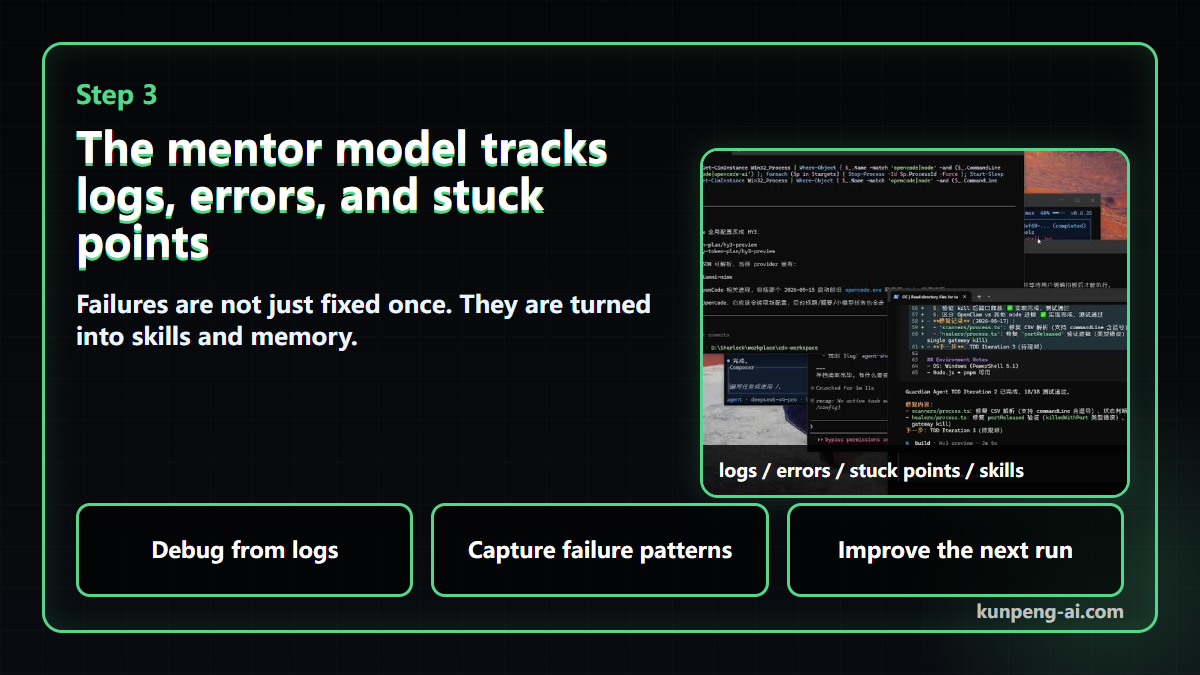
When an executor gets stuck, I do not want to fix the immediate issue and forget it. The mentor model should summarize what happened:
- What triggered the failure?
- Which command or platform behavior caused confusion?
- What should be checked earlier next time?
- Which rule should become part of the project memory?
Those notes become skills, publishing rules, and project handoff documents.
For example, in my current workflow, domestic Chinese platforms and English developer platforms do not use images the same way. Some platforms tolerate public image URLs; others should use uploaded local images. Some article versions can include explicit links; others should avoid naked outbound links. Video templates also have fixed rules: the opening and CTA can be silent while the middle explanation is voiced.
These details are easy to lose if every run starts from a blank prompt. Once they are turned into reusable rules, smaller models make fewer mistakes in later runs.
The human still owns the judgment
I do not see this as full automation.
The human still decides the angle, the risk level, and the final claim. In this case, “make DeepSeek work closer to Claude Code” is a useful hook, but it can become misleading if written carelessly. The accurate version is: DeepSeek can contribute to a workflow that feels closer to Claude Code when a stronger mentor model controls planning, feedback, and validation.
That distinction matters. It keeps the article honest and makes the method easier to copy.
The pattern
The workflow is simple:
- Use a stronger model as the mentor.
- Let it break the job into small, testable tasks.
- Give smaller models bounded execution work.
- Feed logs, failures, and stuck points back to the mentor.
- Turn repeated lessons into reusable skills.
- Keep the human in charge of direction and publishing risk.
This is how I make DeepSeek more useful in real projects. Not by pretending it is Claude Code, but by putting it inside a system where a stronger model teaches, checks, debugs, and improves the next run.
Continue reading
If you want to turn this mentor-model pattern into real project work, continue with these paths:
Key Takeaways
- - The stronger model should plan, define boundaries, supervise, debug, review, and extract lessons
- - Smaller models become more useful when assigned scoped execution tasks
- - Parallel models need process correction, not just more outputs
- - The human still owns the angle, claim boundary, publishing risk, and final judgment
Need another practical guide?
Search for related tools, error messages, setup guides, and engineering notes across the site.
FAQ
Does this mean DeepSeek is the same as Claude Code?
No. The article is about workflow-level results. DeepSeek can contribute to a stronger workflow when a mentor model controls planning, feedback, and validation.
What tasks fit the mentor model pattern?
It fits multi-step tasks with source material, code changes, logs, image assets, platform versions, publishing rules, and final QA.
Why does the human still matter?
The human still decides the angle, risk level, claim boundary, and final publishing judgment.
Voluntary Support
Buy me a coffee
Voluntary support for field tests, server costs, and small open tools. No account, no subscription, no promised delivery.

Alipay QR code
Want to appear on the supporters wall?
After supporting, send your nickname, optional link, and one short note. I will review it manually before publishing.