Brand GEO Strategy: Position First, Then Create Content
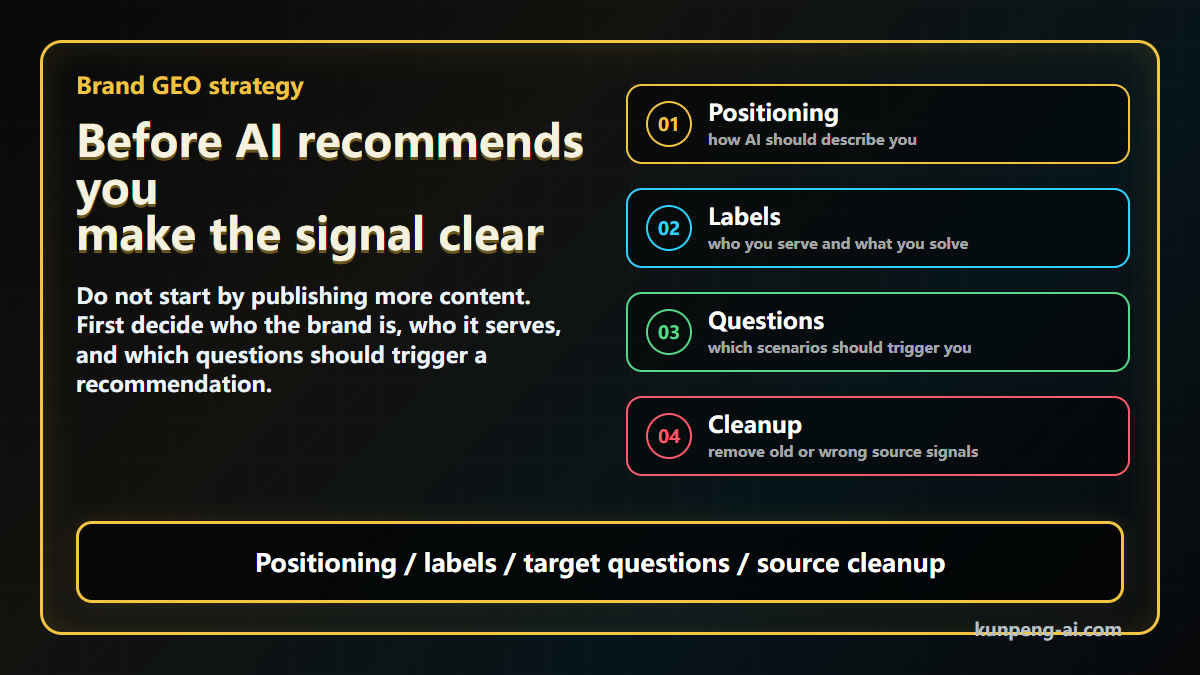
To make AI recommend your brand, do not start with more content. First define your brand labels, design precise recommendation questions, and correct outdated AI understanding.
Main answer
Brand GEO should begin with positioning and target questions, not with publishing volume.
Who should read this
For founders, brand operators, content teams, local service businesses, and teams improving AI-search visibility.
Key check
The article uses hotpot restaurants, renovation companies, and AI brand diagnosis teams to show why precise recommendation questions matter more than generic content volume.
Next step
Write down your three-sentence brand description, target labels, recommendation questions, and wrong-information list before deciding what content to publish.
What You'll Learn
- + Why more content does not automatically create a clearer AI signal.
- + How to define a brand label with audience, scenario, and difference.
- + How to design precise questions that make AI recommendation more stable.
- + Why old addresses, old services, same-name brands, and incorrect reviews should be corrected before publishing more.
Want AI to Recommend Your Brand? Do Not Start by Publishing More Content
When people first hear “make AI recommend my brand,” the immediate reaction is often: should we publish more articles, more videos, and more public content so AI can see us?
That reaction makes sense. In traditional search and social distribution, more coverage often helps. But AI answer engines work differently enough that volume alone can become a weak strategy.
AI is not only asking who is louder. It is trying to answer a user’s specific question. To recommend your brand, it needs a clear public signal: who you are, who you serve, what scenario you fit, and whether the available sources are trustworthy.
So the first step in brand GEO is not to flood the web with content. A better starting point is to answer three questions:
- How should AI describe your brand?
- Which user questions should make AI recommend you?
- Is AI currently misreading your brand or relying on old information?
More Content Does Not Mean a Clearer Signal
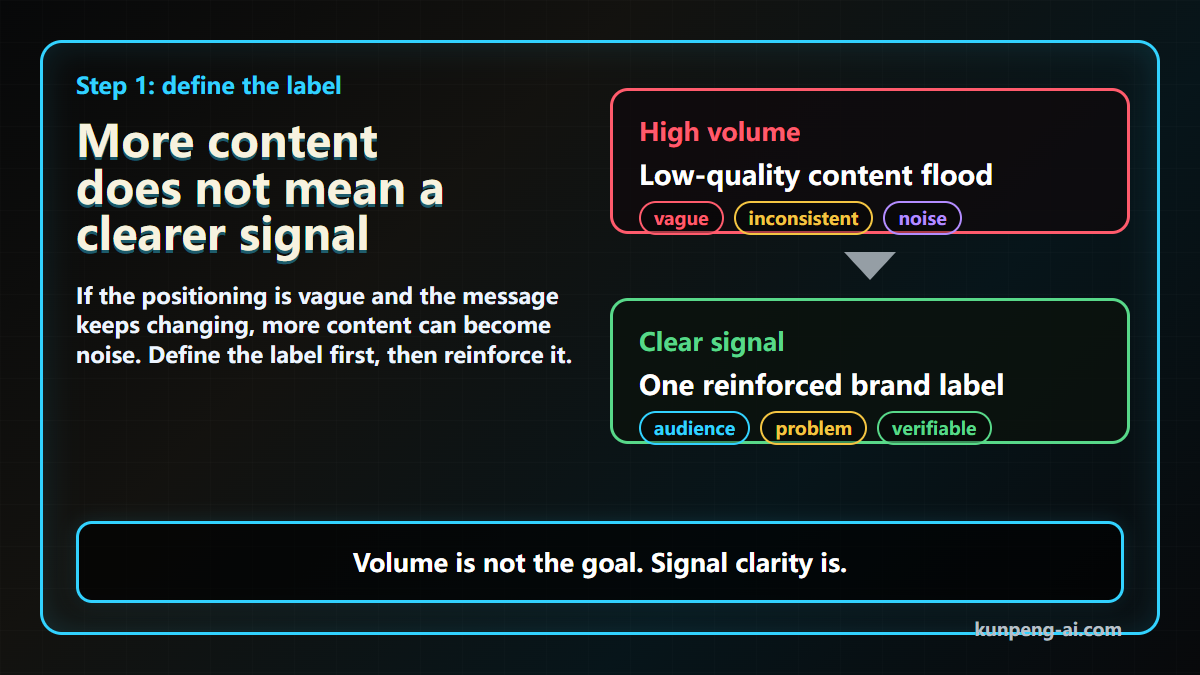
Many brands interpret GEO as “get more content indexed by AI.” The first move becomes obvious: publish more blog posts, more social content, more press releases, or slightly rewritten versions of the same message across different platforms.
The problem is that more content does not automatically become a stronger signal.
If your positioning is unclear, more content can become noise. Today you describe yourself as an “AI tool reviewer.” Tomorrow you are an “enterprise AI consultant.” Next week you become a “brand growth service.” AI may not read this as breadth. It may simply fail to place the brand in a stable category.
Quality matters too. Generic articles without a clear audience, concrete cases, or verifiable process are unlikely to become strong evidence. They may be filtered or treated as low-weight background noise.
The better order is: define the brand label first, then make your site, bios, case studies, articles, and videos reinforce the same signal.
Step 1: Define the Brand Label First
Start with one practical question:
If AI could describe this brand in only three sentences, what should those sentences be?This question is more useful than “how many articles should we publish?”
Avoid labels that are too broad: “AI blogger,” “renovation company,” “hotpot restaurant,” or “brand service provider.” These labels are too large to create a useful recommendation edge.
A stronger label includes audience, scenario, and difference:
- Not just “AI blogger,” but “a hands-on AI tools and workflow reviewer who tests real working processes.”
- Not just “renovation company,” but “a renovation company for small apartments, young homeowners, and projects under RMB 100,000.”
- Not just “hotpot restaurant,” but “a hotpot restaurant near Hongyadong with a good night view and photo-friendly seating.”
The clearer the label, the easier it is for future content to support the same direction. If the label keeps changing, AI has to guess what the brand is for.
Step 2: Design the Questions You Want to Own
Getting traffic from AI does not mean vaguely hoping “AI recommends us.” The useful question is: what should the user ask when AI should think of your brand?
That question should not be too broad.
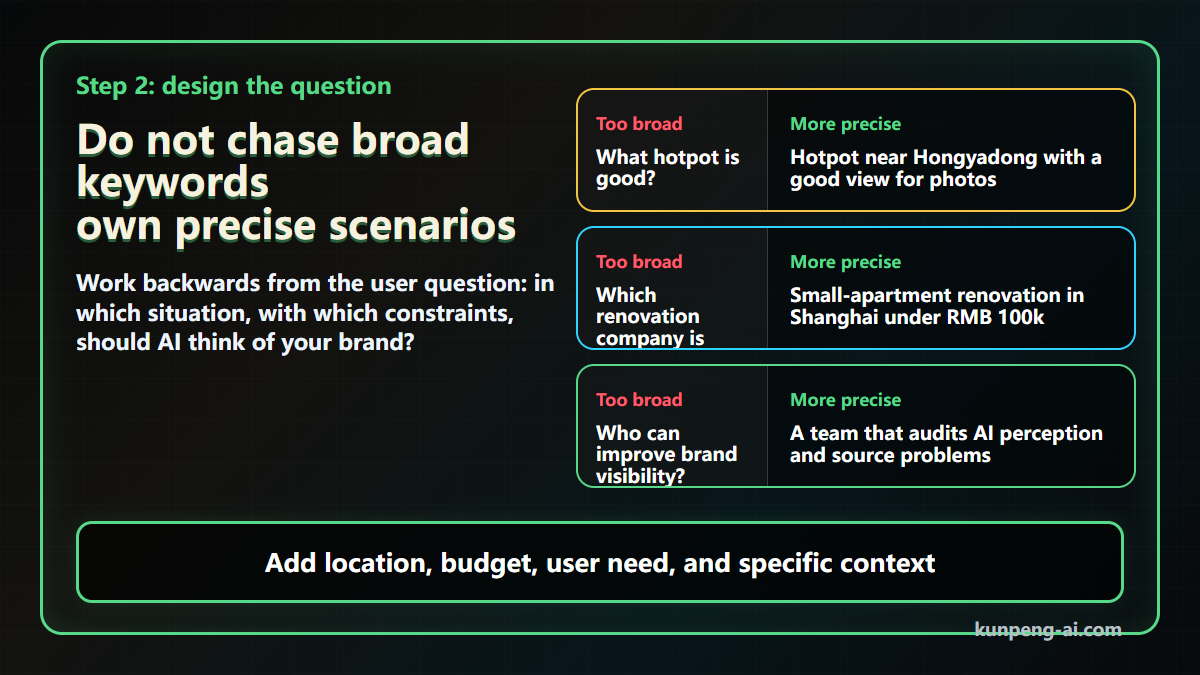
If a hotpot restaurant wants to be recommended for “Which hotpot is good?”, the competition is messy. There is no location, no occasion, no budget, and no user need.
But this question is much clearer:
What hotpot restaurants near Hongyadong have a good view and are suitable for photos?The same applies to renovation companies. “Which renovation company is reliable?” is too broad. A more useful target question would be:
Are there renovation companies in Shanghai that specialize in small apartments under RMB 100,000?For a team that does AI brand diagnosis, do not only chase a broad term like “who does GEO?” A more precise target question might be:
Is there a practical team that can audit how AI describes my brand, which sources it trusts, and whether it carries incorrect information?These questions may not have the largest raw search volume, but they are closer to real buying or decision intent. They also give AI enough context to decide whether your brand is a good recommendation.
Step 3: Check Whether AI Is Misreading You
After designing the target questions, run the process in reverse: ask AI how it currently understands the brand.
This often exposes outdated information.
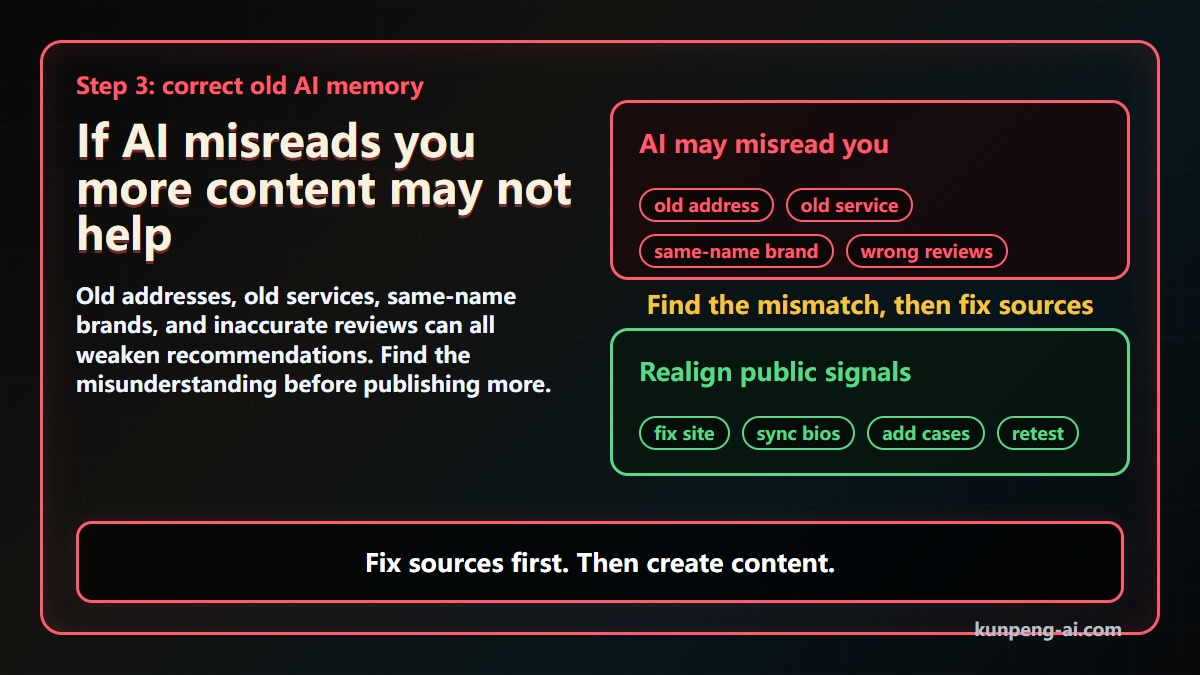
A restaurant may now focus on “near Hongyadong, good night view, suitable for photos,” while AI still describes it as “a regular hotpot restaurant in the old city” and cites an old address.
A renovation company may now specialize in “small apartments under RMB 100,000 for young homeowners,” while AI still sees old large-house renovation projects or even mixes in negative reviews from a same-name company.
In both cases, the current business may be fine. The issue is that AI’s understanding of the brand is stuck in old or incorrect public information.
Ask AI directly:
How do you understand this brand?
Which public sources support that understanding?
Are there old addresses, old services, same-name brands, incorrect reviews, or inaccurate descriptions?
If AI gets something wrong, do not rush to publish more content. First correct the public materials you control:
- Rewrite the homepage and About page so they clearly explain who the brand is, what it does, and who it serves.
- Keep names, bios, avatars, and links consistent across official channels.
- Update case pages so they reflect the current business direction, not only old projects.
- Redirect or reduce references to old domains, old addresses, and outdated service descriptions.
- If same-name confusion exists, add clearer qualifiers to your official site and public profiles.
A Simple Checklist for Brand GEO
You do not need a complex system to begin. Start with this table:
| What to check | What to write down |
|---|---|
| Positioning | What three sentences should AI use to describe us? |
| Brand labels | What are the three labels we want AI to remember? |
| Target questions | What should users ask when AI should recommend us? |
| Constraints | Do those questions include location, budget, audience, scenario, or need? |
| Wrong information | Is AI citing old addresses, old services, same-name brands, or incorrect reviews? |
| Correction action | Should we fix the site, bios, cases, or public profiles first? |
Once this table is clear, content creation becomes more focused.
Articles, videos, case studies, and profile updates are no longer random output. They become repeated evidence for the same signal: who the brand is, who it serves, and when AI should recommend it.
That is the practical starting point for brand GEO.
The goal is not to surround AI with more content. The goal is to make your public information clear enough that AI can understand your brand consistently and accurately.
Key Takeaways
- - Define the label first, design precise recommendation questions second, and correct outdated AI understanding third.
- - Brand GEO is not about surrounding AI with content; it is about giving AI consistent public evidence.
- - Local services such as restaurants and renovation companies need location, budget, audience, and scenario constraints.
- - If AI already misunderstands the brand, more content may amplify noise instead of fixing the signal.
Need another practical guide?
Search for related tools, error messages, setup guides, and engineering notes across the site.
FAQ
Is brand GEO just publishing more articles so AI can index them?
No. Publishing volume is a later step. First, the brand label, target questions, and public materials need to be clear enough for AI to understand the brand consistently.
Why design recommendation questions first?
AI recommendations usually happen inside specific user questions. The more a question includes location, budget, audience, scenario, and need, the easier it is for AI to decide which brands match.
What should we do if AI cites outdated information?
Correct the public materials you control first: homepage, About page, case pages, public profiles, official links, old domains, and old address descriptions. Then publish new supporting content.
Voluntary Support
Buy me a coffee
Voluntary support for field tests, server costs, and small open tools. No account, no subscription, no promised delivery.

Alipay QR code
Want to appear on the supporters wall?
After supporting, send your nickname, optional link, and one short note. I will review it manually before publishing.