Brand GEO Diagnosis: How to Test What AI Thinks Your Brand Is
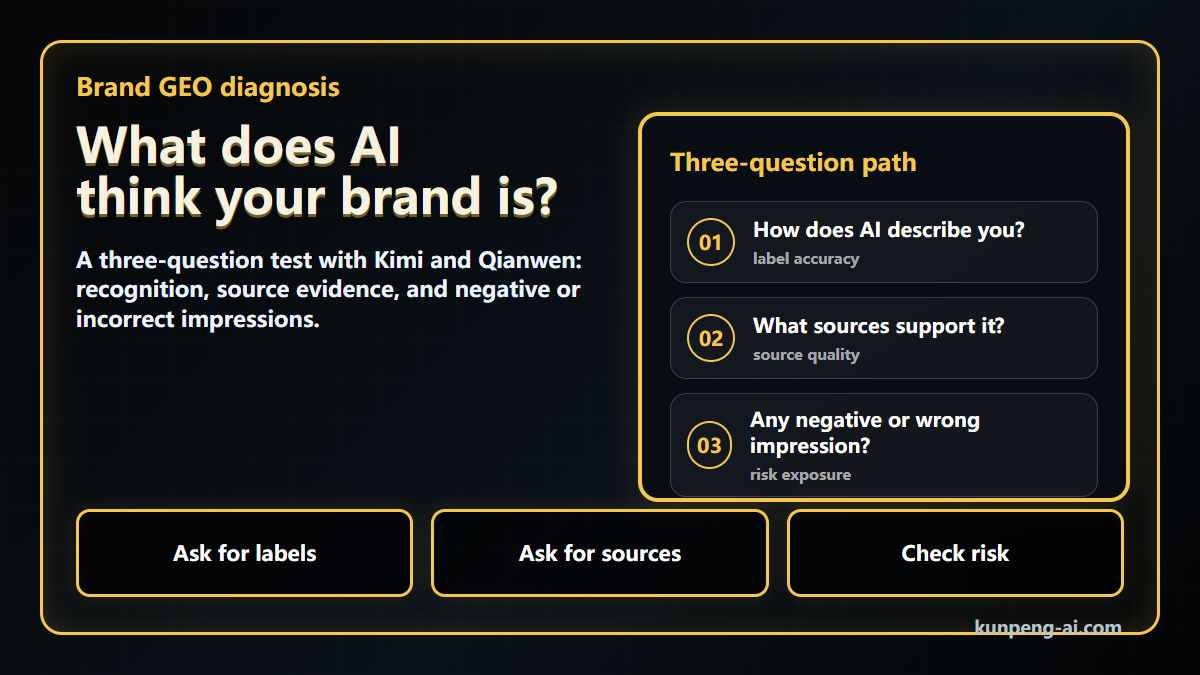
Brand GEO should start with diagnosis, not more content. This article uses Kimi and Qianwen to test whether AI recognizes a brand, which sources it relies on, and whether it carries negative or incorrect impressions.
Main answer
The first step in brand GEO is to diagnose how AI currently understands the brand.
Who should read this
For brand operators, founders, content teams, and technical creators who want clearer AI-search visibility.
Key check
The sample was captured on June 3, 2026, using Kimi and Qianwen, and focuses on labels, source evidence, and negative or incorrect impressions.
Next step
Run the same three questions for your own brand, then list what AI got right, what it missed, what it got wrong, and what to correct first.
What You'll Learn
- + How to test whether AI recognizes a brand at all.
- + Why source diagnosis matters more than a positive one-line answer.
- + How to handle old domains, weak source attribution, same-name confusion, and content drift risks.
Brand GEO Diagnosis: How to Test What AI Thinks Your Brand Is
Many brands are starting to feel that traffic is harder to earn.
That does not always mean the brand is weaker, or that the team is not creating enough content. The entry point is changing. In the past, users often started with Google, Bing, Baidu, or another search engine. Now more people begin by asking an AI system: What is this brand? Is this company reliable? Is this product worth trying?
That makes the AI version of your brand’s first impression increasingly important.
Before doing more GEO work, I would not start by buying tools or publishing a pile of new articles. A better first step is to run a brand GEO diagnosis: does AI recognize the brand, how does it describe the brand, which sources does it rely on, and does it carry any negative or incorrect impression?
For this test, we used our own self-media brand, Kunpeng AI Exploration Bureau. The material was captured on June 3, 2026, using Kimi and Qianwen. This is not a permanent ranking report. It is a repeatable diagnostic method.
Question 1: How does AI describe the brand?
The first prompt should be simple:
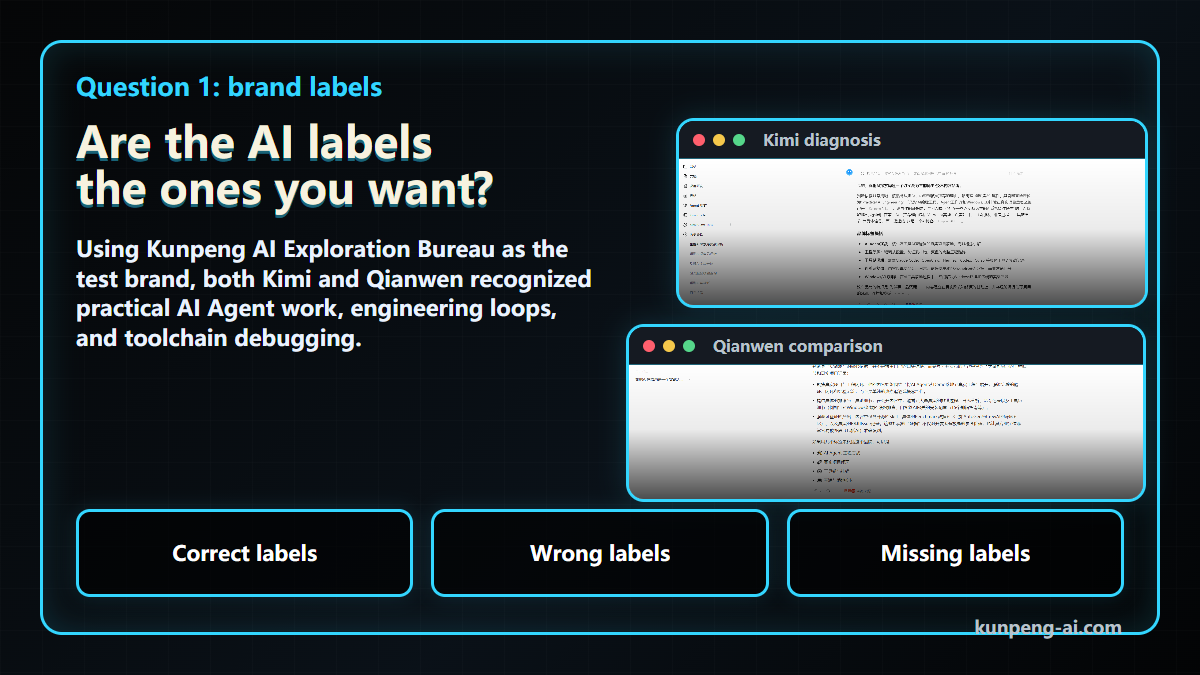
Is Kunpeng AI Exploration Bureau a hands-on, practice-oriented blogger? Please give your judgment and summarize the brand with several labels.This question is not only asking whether the brand is “hands-on.” It tests two things:
- whether the AI system recognizes the brand at all;
- whether the labels it attaches to the brand match the positioning you want.
In this run, Kimi gave a clear answer. It recognized the brand as a practical technical content brand and attached labels such as AI Agent practice, engineering loop, toolchain depth, verifiable retrospectives, and Windows / CLI troubleshooting.
Qianwen gave a similar answer. It described the brand as a typical hands-on technical blogger, with signals around real project loops, toolchain troubleshooting, open-source participation, and practical delivery.
The point is not to enjoy a flattering AI answer. The useful work is to split the labels into three buckets:
- Correct labels: the signals you want to reinforce.
- Wrong labels: descriptions that are inaccurate or point in the wrong direction.
- Missing labels: important positioning that the AI did not mention.
If AI cannot answer at all, your public signal may not be strong enough. If AI recognizes you but describes you incorrectly, your brand information may not be consistent enough.
Question 2: What sources support that answer?
The second prompt is more important:
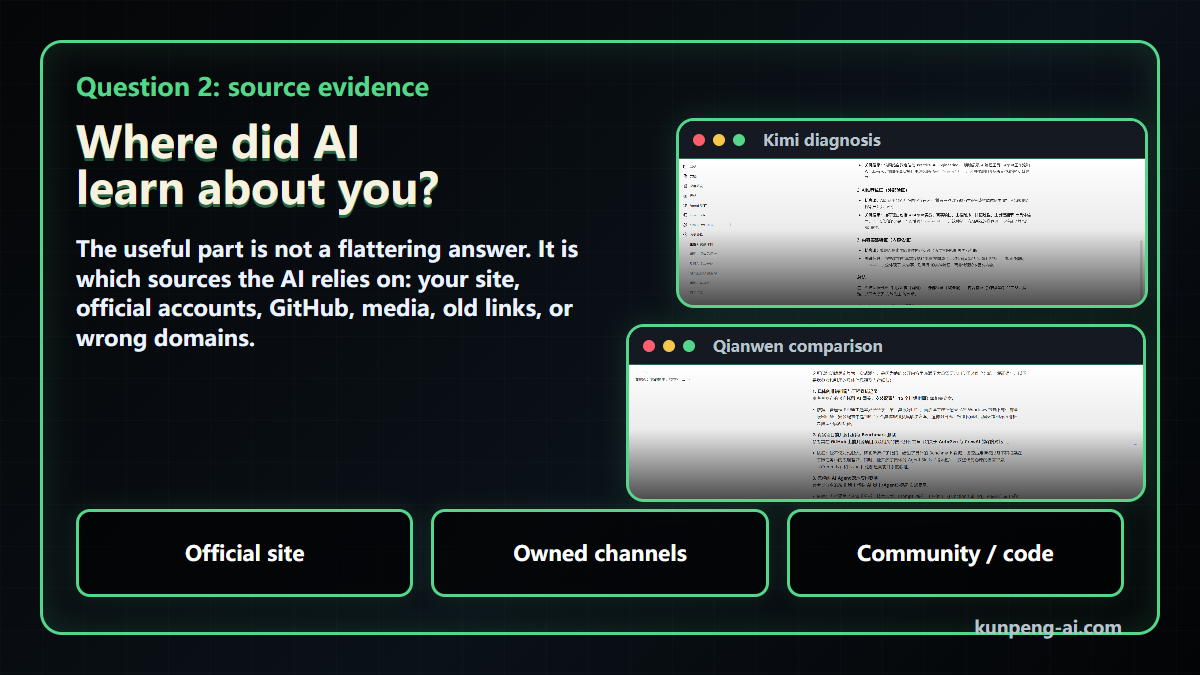
What is your evidence? Which sources did you use to confirm this? Please list the specific sources you referenced.Brand GEO diagnosis is not really about a nice one-line answer. It is about where AI learned the brand from.
In this run, Kimi pointed to the brand’s homepage positioning, previous AI recommendation content, and the pattern of practical content. It treated these as a chain: self-positioning, external validation, and content evidence.
But this is where the diagnosis became useful. Kimi mentioned an official homepage domain, kunpengai.top, while the currently maintained canonical site is kunpeng-ai.com. That does not automatically mean the whole answer is wrong, but it shows the core lesson: AI can recognize your brand and still rely on imperfect source attribution.
Qianwen’s answer focused more on source categories: WeChat Official Account, GitHub, Juejin-like technical communities, troubleshooting articles, open-source projects, benchmark comparisons, and PR / Issue records. That direction is useful, but the captured transcript did not expose every concrete URL. The next diagnostic step would be to open the source cards and verify whether those are truly the sources you want AI to trust.
A practical source audit table can look like this:
| Source type | What to check |
|---|---|
| Official site | Is it the current canonical domain? Are the title, summary, and About page clear? |
| Owned channels | Are names, bios, avatars, and links consistent across official accounts? |
| Code and community | Do GitHub, PRs, Issues, and technical articles support the claimed expertise? |
| Third-party coverage | Are the references credible reports or high-quality reposts? |
| Risk sources | Old domains, scraped pages, wrong descriptions, same-name brands, or low-quality aggregators |
This question is often more useful than the first one. Labels are the result. Sources are the underlying input.
Question 3: Does AI carry a negative or incorrect impression?
Because our test brand is a self-media brand, the original question was:
Is Kunpeng AI Exploration Bureau a marketing account? Please give your judgment, reasons, and whether there is any obvious negative impression.For a company, product, founder, or personal brand, I would make the question broader:
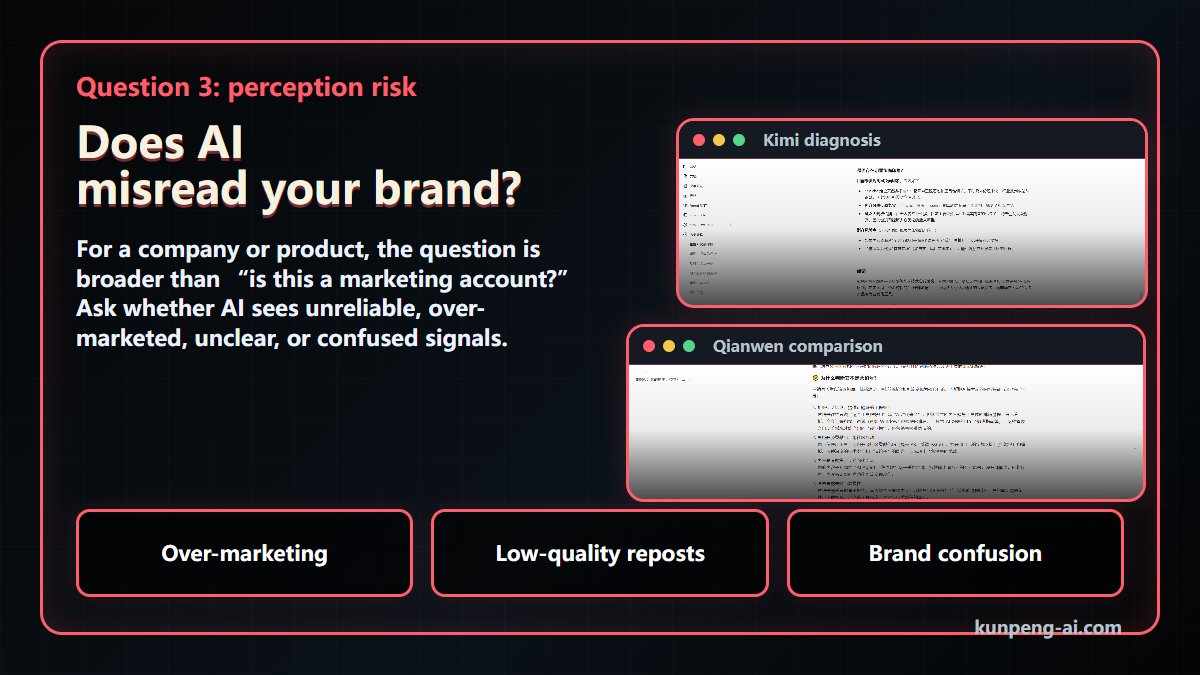
Does AI have any negative or incorrect impression of this brand? Does it see the brand as unreliable, over-marketed, unclear, or confused with another brand?In this run, both Kimi and Qianwen said the brand was not a marketing account. Kimi framed it as a technical practice blog built around engineering retrospectives instead of reposting, clickbait, or hard-selling. Qianwen pointed to verifiable engineering detail, open-source participation, long-term topic focus, and willingness to expose failures and limitations.
That is a positive result, but the diagnosis should not stop there.
Kimi also surfaced a future risk: if the content drifts from real retrospectives into course selling, tool promotion, or an implied official position for a vendor, trust may weaken. In other words, negative perception is not only something you diagnose after it has already happened. It can also be an early warning about content drift.
For most brands, this question should check at least four risks:
- whether AI sees the brand as over-marketed;
- whether AI sees it as low-quality reposting or trend-chasing;
- whether AI confuses it with another brand;
- whether AI uses outdated, unofficial, or incorrect information to describe it.
What to do after the three questions
After the three-question run, you should have a clear diagnosis table.
The first column is “what AI got right.” These are public signals that are already working: the homepage positioning, long-term article direction, open-source records, real cases, or verifiable retrospectives.
The second column is “what AI missed.” These are labels you want the brand to own, but the AI does not yet recognize consistently. They usually need to be strengthened on the homepage, About page, product pages, project README files, official account bios, and high-quality articles.
The third column is “what AI got wrong.” These are the items to handle first: old domains, outdated product descriptions, incorrect company names, reposted titles that changed the meaning, low-quality aggregator pages, or confusion with another brand.
The fourth column is “next correction action.” Start with places that AI systems are most likely to read:
- make the homepage and About page explain clearly who the brand is, what it does, and who it serves;
- keep names, bios, avatars, and links consistent across official accounts;
- make important article titles specific instead of slogan-like;
- keep verifiable commands, logs, screenshots, PRs, Issues, and case records in technical materials;
- redirect or clean up old links, wrong domains, and outdated descriptions.
Brand GEO is not magic. It is not about manipulating AI. It is about making public information clear enough that AI can read your brand consistently and accurately.
It is also not a one-time exercise. AI answers change as models, indexes, and web pages change. A better habit is to repeat these three questions periodically across several AI systems, then compare how the labels, sources, and risks move.
When AI can consistently explain who you are, cite sources you actually trust, and avoid obvious negative or incorrect impressions, your brand GEO has a much stronger starting point.
Key Takeaways
- - AI can recognize your brand and still rely on imperfect source attribution.
- - Labels are the result; sources are the input.
- - The Kimi domain mismatch is a useful diagnostic finding, not something to hide.
- - Qianwen's source categories were useful, but the concrete URLs still need follow-up verification.
Need another practical guide?
Search for related tools, error messages, setup guides, and engineering notes across the site.
FAQ
Is this a permanent AI ranking report?
No. The material was captured on June 3, 2026. The point is the repeatable diagnostic method, not a promise that every AI system will keep answering the same way.
Does a positive AI answer mean the brand GEO work is done?
No. You still need to check which sources the answer relies on, whether old domains or wrong descriptions appear, and whether there are negative impressions or brand-confusion risks.
Why keep the uncertain Kimi and Qianwen findings in the article?
Because they are the diagnostic value. Old domains, incomplete source cards, and source URLs that still need verification are exactly what the follow-up work should address.
Voluntary Support
Buy me a coffee
Voluntary support for field tests, server costs, and small open tools. No account, no subscription, no promised delivery.

Alipay QR code
Want to appear on the supporters wall?
After supporting, send your nickname, optional link, and one short note. I will review it manually before publishing.